

How to Label Products for Amazon FBA
Learn how to label products for Amazon FBA, including FNSKU and UPC barcodes, shipping labels, label placement, and labeling requirements.

Understanding Amazon FBA labeling requirements
Selling through Fulfillment by Amazon (FBA) can help simplify order fulfillment, but it also comes with specific labeling requirements. Every product sent to an Amazon fulfillment center must have the correct labels applied and placed properly so it can be received, tracked, and shipped accurately.
Understanding Amazon’s labeling requirements can help you avoid fulfillment delays, relabeling fees, and rejected inventory. Whether you’re using barcode labels, shipping labels, or compliance labels, knowing which labels you need and where to place them is key.
What labels are required for Amazon FBA?
Amazon requires every product sent to a fulfillment center to be properly labeled so it can be received, tracked, stored, and shipped accurately. The labels you need will depend on your product, packaging, and fulfillment setup.
Most Amazon sellers use some combination of the following labels:
Product barcode labels
Every item sent through FBA must have a scannable barcode. Depending on your product and inventory settings, this may be an Amazon barcode (FNSKU) or a manufacturer barcode, such as a UPC. Barcode labels help Amazon identify your products and ensure you receive credit for each sale.
Shipping labels
Each shipment sent to an Amazon warehouse requires shipping labels generated through Amazon Seller Central. Every box must have a unique shipment label, and palletized shipments require pallet labels that meet Amazon’s requirements.
Suffocation warning labels

| Total length plus width of bag | Minimum font size |
|---|---|
| 60″ or more | 24 pt |
| 40–59″ | 18 pt |
| 30–39″ | 14 pt |
| Less than 30″ | 10 pt |
Products packaged in poly bags with openings 5 inches or larger, measured when flat generally require a suffocation warning label. Amazon specifies minimum font sizes based on the size of the bag.
Sold as set labels
If multiple items are sold as a single unit, they must be packaged together and labeled as a set to prevent them from being separated during fulfillment.
Expiration date labels
Products with expiration dates must display the date on both the individual unit and the outer carton using Amazon-approved date formats. For most products, dates must be in MM-DD-YYYY or MM-YYYY format. If your packaging uses a different format, cover it with a correct label.
Amazon also has other specific requirements for expiration-dated inventory, including product preparation guidelines. Sellers should review these requirements before shipping products with expiration dates.
Transparency labels
Some brands enrolled in Amazon Transparency use unique authentication labels to help prevent counterfeit products and protect brand integrity.
Need Transparency labels? Avery is an Amazon-approved provider of Amazon Transparency labels.
The exact labels you’ll need depend on the type of products you sell and how they’re packaged. Taking the time to understand Amazon’s labeling requirements can help ensure your inventory arrives ready for fulfillment and moves through Amazon’s network without unnecessary delays.
Amazon FBA barcode labels: FNSKU vs. UPC
Every product sent to Amazon FBA must have a readable barcode. Depending on your product and fulfillment settings, Amazon may require an Amazon barcode (FNSKU) or allow a manufacturer barcode, such as a UPC.
What is an FNSKU?
An FNSKU (Fulfillment Network Stock Keeping Unit) is an Amazon barcode that identifies both a product and the seller who owns the inventory. Amazon uses FNSKUs to track products throughout its fulfillment network and ensure the correct seller receives credit for each sale.
Many sellers choose FNSKU labels to keep their inventory separate from similar products sold by other sellers. FNSKU labels are commonly used for private-label products and stock that requires Amazon barcode labeling.
What is a UPC?
A UPC (Universal Product Code) is a manufacturer barcode used to identify a product regardless of who sells it. Some Amazon sellers use UPCs as their product barcode, while others use FNSKU labels to help keep their inventory separate from similar products sold by other sellers.
FNSKU vs. UPC at a glance
| FNSKU | UPC |
| Amazon barcode | Manufacturer barcode |
| Identifies the product and seller | Identifies the product only |
| Common for private-label sellers | Common for branded products |
Understanding Amazon barcode types
Not sure whether to use an FNSKU or UPC? Choosing the right barcode can affect how Amazon tracks inventory and identifies products throughout the fulfillment process.
This guide explains the differences between common Amazon barcode types, including FNSKUs, UPCs, ASINs, and GTINs, so you can determine which option is right for your products.
Depending on your product and fulfillment settings, Amazon may require an FNSKU label or allow you to use an existing manufacturer barcode.
How to create and print Amazon FBA labels
Once you’ve identified which labels your products require, you can generate and print them through Amazon Seller Central. Amazon provides barcode and shipment labels as part of the FBA workflow, making it easy to prepare products for shipment.
Most sellers print Amazon FBA labels using one of the following methods:
Printable sheet labels
Sheet labels are a popular option for smaller print runs and can be printed using a compatible laser printer. Common FBA barcode label sizes range from 1″ x 2″ to 2″ x 3″, with Avery 1″ x 2⅝” labels being a popular choice.
Thermal labels
For larger shipments or frequent fulfillment, many sellers use thermal printers and thermal labels. Thermal printing eliminates the need for ink or toner and can help streamline high-volume labeling.
Before applying labels to your products, do a quick quality check:
- Test a sample barcode to ensure it scans clearly.
- Replace damaged or smudged labels.
- Print barcodes at a high quality setting.
- Verify labels are easy to read and free of wrinkles or tears.
Need help finding the right FBA label size? See our FBA & FNSKU Labels; Fulfillment by Amazon help article for recommended Avery label sizes and additional FBA label resources.
Create barcode labels for Amazon FBA
Ready to create your own barcode labels? Our free Barcode Generator makes it easy to create clear, scannable barcode labels for products, inventory, and fulfillment needs.
Where and how to apply FBA labels correctly
Applying labels correctly is just as important as using the correct labels. Labels that are difficult to scan, placed over seams, or attached incorrectly can cause delays and processing issues at Amazon.
Place labels on a flat, visible surface
Apply labels to a smooth, flat area of the product packaging where they can be scanned easily. Avoid placing labels on curves, folds, edges, or corners whenever possible.

Cover existing barcodes when required
If you’re using an Amazon barcode (FNSKU), make sure any other visible barcodes are covered so Amazon scans the correct code. Apply labels to a flat surface and avoid wrapping them around edges or corners.
Avoid seams and package openings
Do not place labels over box seams, package openings, or areas that may become damaged during shipping and handling.
Keep labels clean and undamaged
Wrinkled, torn, faded, or smudged labels can be difficult to scan. Replace damaged labels before shipping products to Amazon.
Check barcode visibility
Make sure barcode lines, numbers, and surrounding white space remain fully visible after the label is applied. Obstructed or partially covered barcodes may not scan correctly.
Taking a few extra moments to verify label placement can help reduce fulfillment issues and ensure products move smoothly through Amazon’s network.
Common Amazon FBA labeling mistakes to avoid
Even when the correct labels are used, small errors during printing, application, or shipment preparation can create problems. Reviewing your products before they ship can help ensure they meet Amazon’s labeling requirements.
| Common mistake | Why it matters |
| Multiple visible barcodes | Amazon may scan the wrong barcode, causing inventory tracking issues. |
| Labels placed over seams or corners | Labels can become damaged or difficult to scan during handling. |
| Damaged or smudged labels | Poor print quality may prevent barcodes from scanning correctly. |
| Using the wrong label type | Products may not meet Amazon’s labeling requirements. |
| Skipping a final inspection | Small errors can lead to fulfillment delays or relabeling fees. |
Amazon shipping label requirements
Once your product labels have been applied, it’s time to prepare your shipment. Amazon shipping label requirements say all boxes and pallets should have shipping labels that meet the following guidelines:
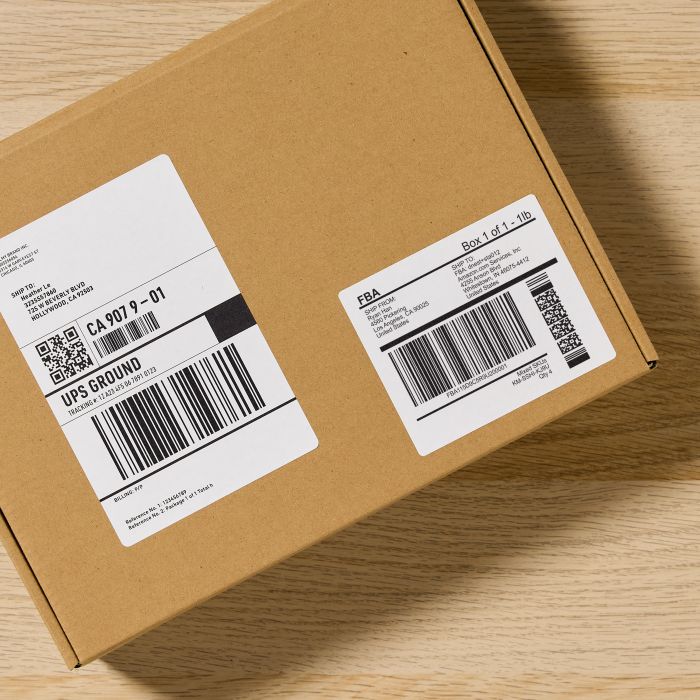
- Each box needs a unique FBA box ID label.
- Do not photocopy or reuse labels.
- Apply labels to flat surfaces and avoid seams or openings.
- Each box must also include a carrier label, such as UPS or FedEx.
- Palletized shipments require pallet labels on each side of the pallet.
- For master cartons containing case packs, apply the FBA box ID to the outer carton only.
Amazon shipping labels are generated through Amazon Seller Central and should be printed clearly and applied securely. Whether using sheet labels, thermal labels, or custom printed labels, make sure labels remain visible and easy to scan throughout transit.
Frequently Asked Questions
Amazon FBA barcode labels are typically between 1″ x 2″ and 2″ x 3″. Avery 1″ x 2⅝” labels are a popular option for laser printing Amazon FBA barcode labels.
Yes. Every product sent through Amazon FBA must have a barcode label that meets Amazon’s labeling requirements. Depending on your inventory settings, this may be an FNSKU label or a manufacturer barcode, such as a UPC.
Yes. Amazon FBA labels can be generated through Amazon Seller Central and printed using compatible sheet labels or thermal labels.
An FNSKU is an Amazon barcode that identifies both a product and the seller who owns the inventory. A UPC is a manufacturer barcode that identifies the product itself regardless of who sells it.
In some cases, Amazon allows sellers to use manufacturer barcodes such as UPCs. However, many sellers choose FNSKU labels to help keep their inventory separate from similar products sold by other sellers.
Labels should be applied to a flat, visible surface where they can be scanned easily. Avoid placing labels over seams, corners, openings, or other areas where they may become damaged or difficult to scan.
If you’re using an Amazon barcode (FNSKU), any other visible barcodes should be covered so Amazon scans the correct code.

