

Event Marketing Ideas: An Easy Guide to Selling More
Explore smart marketing ideas for small business events. Get tips to sell more and stand out at your next event, or your very first one.
What you’ll learn about event marketing in this guide
Here’s a quick overview of what you’ll find in this guide—simple, effective marketing ideas for small business owners who sell at events, markets, and pop-ups.
Table of contents
What I wish I had known about event marketing when I started
I’ve spent more than a decade selling at craft fairs, conventions, and other in-person events. Of course, you want to make a profit and make every event worth your time. But selling goes deeper than dollars: attracting new customers, generating leads, and encouraging repeat business are important opportunities too. If you only remember five things from this guide, make them these.
- Wear a name tag—even if you work alone. It identifies you as the person behind the business. That makes it easier for customers and other vendors to start conversations.
- Make every price easy to find. Clear price tags and signs remove hesitation, help customers shop independently, and make it easier for friends or family to help at your booth.
- Plan for follow-up before the event. Bring business cards, display a QR Code®, or collect email sign-ups. These things help interested shoppers reconnect—even if they don’t buy that day.
- Use a small freebie as an icebreaker. A sticker or sample gives people a low-pressure reason to stop, interact, and learn more about your business.
- Consider taking pre-orders. Selling before the event can help cover your booth fee and protect some of your revenue. That’s important because sometimes weather or low foot traffic can cut your sales.
The big picture that became clear over time
In real life, when friends starting a business ask me for advice, one of the first things I tell them is that networking and marketing are about more than collecting or handing out contact information at events. This is your time to reach customers face-to-face. Every time you hand out a business card or someone stops at your booth, it’s your chance to create a genuine connection that reflects your brand’s personality and builds trust and establishes credibility. A generic (or worse—sloppy) look and feel can easily derail those connections.
On the other hand, an interesting card that sparks conversation or a well-designed display can make a lasting impression long after the event is over. Every detail, from your signage to your packaging, tells a story about who you are and what your business stands for.
When those moments feel authentic, people remember you—and that’s what drives repeat customers and referrals. The marketing ideas in this guide will help you turn those authentic moments into measurable results by helping you build trust, boost awareness, and drive sales. You may be ordering your first professional business card or ready to upgrade promotional materials for your event. Either way, every idea should support the business goals you outline for the event.
Curious what you can customize? Avery marketing materials are an easy entry point for beginners with lots of options to scale up as your business grows.
How to make good ideas great: define your goals
Prepping for an event is a lot of work, but it’s totally worth setting goals before your next event—or your first. I’ve never met a small business owner with endless resources. In reality, budgeting time and money is usually critical. That’s why I always recommend setting clear goals. Clear goals help me focus my time and resources on the event marketing ideas that will make the biggest impact. So, it’s worth investing the time upfront to define what success actually looks like.
And after all, events are not the entirety of your business. Instead, you might want to think of each one as a piece of a larger marketing puzzle. That’s exactly what I’ve seen in person at craft fairs and conventions. Even though the goals they set and how they measure success might be different, the most successful vendors connect what they do at events back to their overall business strategy. For example, one small business might measure success by the number of products sold. Another might focus on collecting email addresses for future promotions. Whatever your approach, the key is clarity.
How to set goals and measure event marketing success
- Define what you hope to achieve.
- Decide how to collect data and track KPIs.
- Review to see what’s working.
Start by defining what you hope to achieve. Are you aiming to make direct sales, grow your email list, or gain social followers? Maybe you simply want to get your name out there. When you know what you’re working toward, every conversation, sale, and interaction becomes more intentional—and more rewarding.
Then decide which key performance indicators (KPIs) will help you measure success and how you’ll collect the data. For example, tracking leads, sign-ups, or even meaningful conversations you have during an event can tell you how you’re doing. It might sound tedious, but collecting this data is crucial. It helps you figure out what’s working in your marketing strategy—or what to adjust next time.


Plan your budget: affordable, DIY marketing ideas for small businesses
Once you know your goals, marketing doesn’t have to drain your budget to make an impact. In fact, some of the most effective event marketing I’ve done has been simple, affordable, and hands-on, like sticker freebies. If you’re a small business owner like me, every dollar counts—so it’s important to think in terms of marketing ideas that return on effort as much as your investment. Anything that can be reused across multiple events, like display signs, banners, or branded postcards, is worth the extra time and money upfront.
DIY doesn’t mean it looks low-budget; it means smart-budgeting
Sometimes that means planning a fair bit ahead because you have to think of what can work in any season. A great place to start is with materials like business cards since your contact information and branding aren’t likely to change within a year. Then I think about materials that are an easy swap. For example, I might order custom-printed promo postcards in bulk, but I’ll use printable postcards for table signage. Avery printable postcards that fit into a 5″ × 7″ table stand make it easy to print and swap new postcards as needed.
Indeed, printable Avery labels, tags, and cards give you the freedom to experiment with looks, test ideas, and stay flexible if your product mix changes. Case in point: I once revamped my booth look for under $40. I used leftover packaging labels, a few new holiday-themed tags, and printable tent cards turned into mini signage. It looked completely new but cost me next to nothing and reduced waste. The key is to start with quality basics and keep building from there.
Create polished event marketing materials with the right tools
When you’re juggling a million details before an event, design should be the fun part, not the stressful part. That’s why I lean on Avery templates and the free design tool. Using them together, I can create everything from product labels and name tags to thank-you stickers and promo cards. What I love most is that I can preview my designs and adjust as necessary before printing or ordering. I’m all about the details, and misaligned product labels absolutely will keep me up at night. Whether I’m having my promotional materials custom printed or printing at home, I can obsess over details without losing sleep.
Not just on a case-by-case basis, either. Having the right tools also helps me keep my branding consistent without extra effort. I keep a few go-to templates saved for recurring designs—like booth signage, product cards, and price labels—so I can update details quickly instead of starting from scratch. For larger events or when I need something extra polished, I’ll use Avery custom-printing services to handle the heavy lifting. I love being able to switch between DIY and professional printing because it gives me creative control without sacrificing convenience.
Use free designs for your small business marketing materials
If you’re not sure where to start, the Avery Shop by Design feature makes it even easier. When you see a design you like, you can preview it across a variety of products. Then all you have to do is just click, customize, and order. It’s perfect if you want professional-looking materials without needing design experience. And I’ll be honest, even though I’ve locked in my brand guidelines, I still love creating marketing materials this way. I start with the template then apply my brand colors, customize the text, and add my logo. I don’t have to think about how to translate it to each product size, it’s already done.
Build professional credibility with smart event marketing ideas
Never underestimate the power of looking the part. When your branding is consistent across signage, packaging, and materials, it increases your professional credibility at first glance. Not only that, but it gives you an inner boost as well. I found that when my booth looked professional and pulled together, it actually made me feel different. I was proud of what I was presenting so I carried myself with more confidence.
When my booth looked professional and pulled together, it actually made me feel different.
Product labels are part of your event marketing
Looking (and feeling) like a real business when you’re out vending in the real world starts with your product labels. They’re a vital part of how your booth feels and comes across to customers before you ever set up a single table or sign. Coordinated labels and tags carry your logo, colors, and brand personality across your display, helping every item feel connected to your business.
At a busy event, product labels can also answer common questions when you can’t speak to every shopper at once. Depending on what you sell, they might identify the product name, scent, flavor, size, ingredients, or care instructions.
They’re also going to get handled… a lot. If you’re at a busy farmers market, hundreds of hands might touch your labels—at a big convention, maybe thousands. It’s worth it to choose a material that suits the product and how it will be handled, especially if it may be exposed to moisture or oils. Messy, smudged, or worn out labels that look cheap are missed marketing opportunities.
Vendor booth display ideas
Aside from large vinyl banners, there are a few marketing materials that boosted my booth’s presence (and my confidence) the most. These were business cards, name tags, table display signage, price tags, and branded packaging. When I was ready to level up even more, I started to look for new event marketing ideas for my small business. That’s when I started creating promo cards to encourage online sales and custom freebie stickers to draw in potential customers. Getting people to stop at your booth in a sea of booths is honestly half the battle.
As a matter of fact, that’s the driving force behind the vendor booth ideas I learned from vending at a local comic convention. Here are a few more vendor booth display ideas you can easily achieve even on a small budget your first time out.
Use levels—keep the eye moving
Varying heights can make your display more dynamic, draw attention to key products, and help shoppers see everything at a glance. I like using grid and connector shelving because it’s easy to assemble and packs up compactly. But I’ve also seen great setups using gift boxes, collapsible crates, and even vintage suitcases.
Group similarly priced items together
This helps customers compare options quickly and encourages impulse buys. For example, my highly detailed handmade headpieces are priced accordingly, but I also offer simpler, more affordable versions. On my table, I use tent cards to identify price ranges, so that if a higher-priced piece isn’t in someone’s budget, they can easily spot other options that fit. And great deals, like one-dollar pins, always draw attention.
Make sure prices are clear
No one likes to guess what something costs. Easy-to-read price tags make browsing and buying more comfortable for customers. I also tag everything so if friends or family help at my booth, they don’t need to memorize prices or check a list—it keeps things simple for everyone. This is one of the easiest and most helpful event marketing ideas I share with other small business owners.
Use signage to capture leads
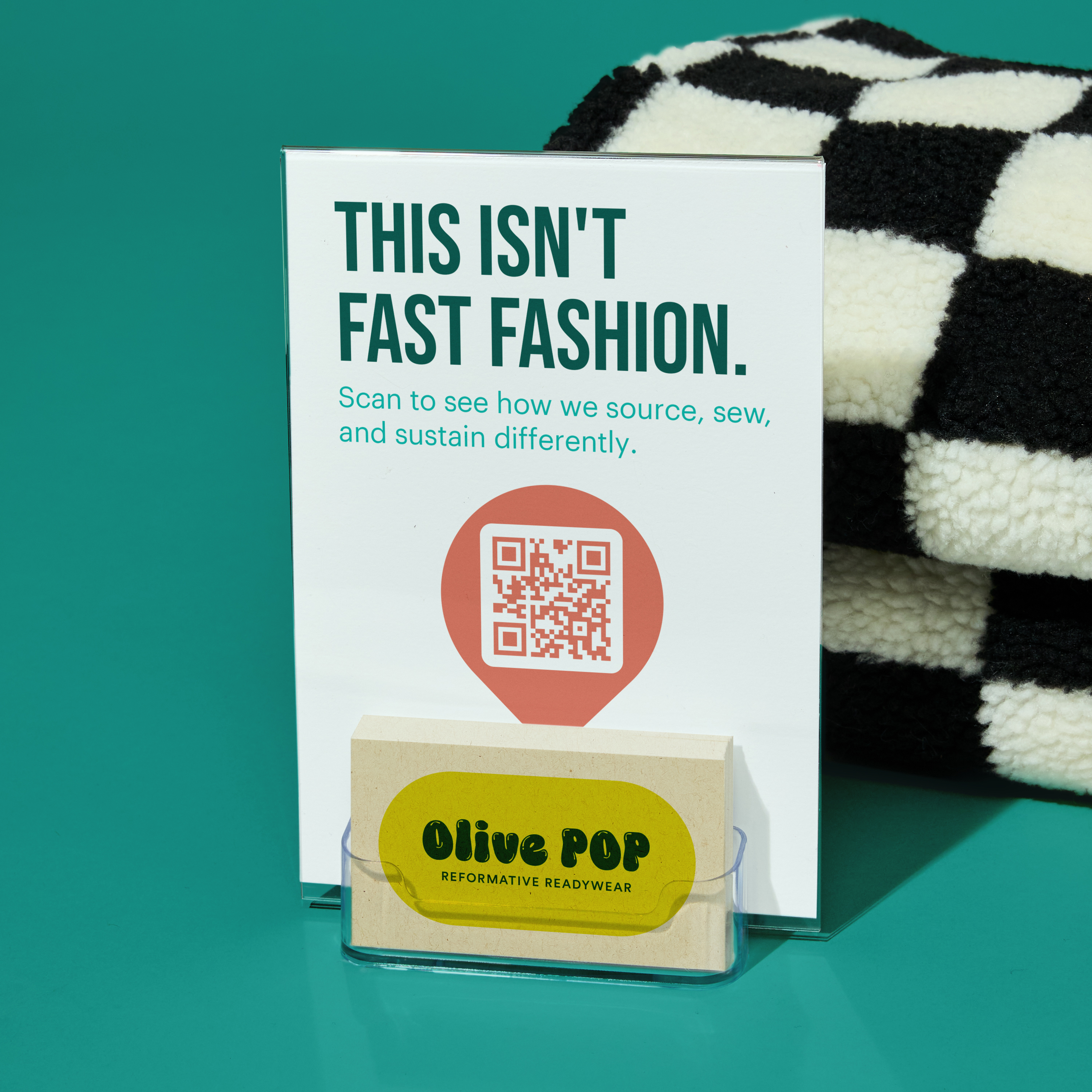
I never go to an event without a small sign featuring a QR Code that links to my website, mailing list sign-up, and accepted payment methods. It’s easy to print a simple sign inviting people to join your list or follow you on social media—just use a sheet of paper or a postcard in a tabletop stand. Even if they don’t buy that day, it keeps your business top of mind for future sales.
Introduce yourself with your branding
Your booth should instantly tell people who you are and what you offer. When branded materials like business cards, labels, and signs work together, they create a polished, memorable impression. One of my favorite tips for vendor booth displays is to get a 5″ × 7″ acrylic stand with combo sign and business card holder. It doesn’t take up much real estate but really feels like an introduction: the sign says, “Hello,” the cards say, “Let’s keep in touch.”
Small business checklist for events
- Banners
- Tent cards for table signage
- Social follow/email sign-up signs
- Price tags
- Product labels
- Business cards
- Name tags
- Promo cards
- Stickers
- Swag bags
Perfection isn’t the goal—showing up prepared is. Focus on things you can control so that you’re free to make genuine connections.
Get the word out with pre-event marketing ideas for small business
Social media teasers and countdowns
A little pre-event buzz can go a long way. My go-to move is sharing work-in-progress (WIP) photos that don’t give away every detail—just enough to make people curious. A quick countdown post or story is another fun way to build excitement. I also like adding a small incentive, like a discount for the first few visitors who follow me online. It’s the perfect extra nudge to get people to find your booth in person.
Partnering with event hosts or vendors for cross-promotion
I’ve learned not to underestimate the power of a good tag or shoutout. I’ve teamed up with nearby vendors to share each other’s posts, and I was surprised at how fast it extended my reach. Plus, it just feels good to build up other small business owners and share marketing ideas instead of competing for the same spotlight. I like to think of it as networking—but with stickers and snacks.
Offering pre-orders or event-exclusive deals
Selling ahead of the event kind of disaster-proofs your experience because you know there are already sales in the bag. Even if foot traffic is bad, it rains, or excessive heat keeps crowds away, I often make back my booth fee in pre-orders alone. That way, whatever happens, it was worth it to be there. Event-exclusive deals are a double bonus because they help encourage folks to come out and also help me close sales on the spot.
How promotional materials boost pre-event buzz
Flyers, postcards, and stickers are your silent hype team. They work even when you’re not around. I use them two ways. Firstly, I always keep a little stash handy to slip into online orders leading up to an event. Secondly, I always take promo cards with me for the next event. Oh, you love my creations? Why not come see me at the next place? It’s low-cost marketing with high charm, and it starts to make your brand feel like a friend. Hello loyalty!
Engage customers and stand out with creative event marketing ideas
Be present and approachable
When it comes to connecting with people at events, the most important thing you can do is be present. To be frank, all the fancy marketing ideas in the world can’t get people to care about a small business if the owner is detached. Don’t hide behind your phone or work on other projects during the show. I even swapped the standard folding chair for a director’s chair—it keeps me at eye level with shoppers and helps me stay fully engaged.
This is important because when you’re focused and engaged, you’ll naturally start saying hello to everyone who walks by. Just that simple greeting goes a long way. I also like to offer freebies to passersby, like a sticker (free samples are also very enticing). It gives me an easy icebreaker and a reason to connect.
In fact, everyone who knows me as a vendor knows that free stickers are my secret weapon, but my second secret weapon is a branded name tag. It helps customers quickly see who belongs to which booth—but it also helps you connect with other vendors.
If you’re browsing booths, they’re more likely to chat with you as a potential customer too. But if you have a name badge that clearly identifies you as a vendor, you’ll find people are ready to network, swap stories, and spill the real tea on how the event’s going.
Stay positive and authentic
Positivity matters just as much as presence. I’ve met so many talented makers who let their nerves or frustration take over. But when your booth energy is heavy—lots of talk about what you wish you’d done or couldn’t finish—it can drive people away. Customers are there for a fun experience, not to absorb stress. You don’t need fake cheer, just genuine enthusiasm for your work and the people stopping by.
And speaking of genuine, that’s the next big one—authenticity. If you love someone’s earrings, tell them. If a shopper picks up your favorite product, share why you love making it. But don’t overdo the flattery or make up stories to please people. Visitors can tell when you’re being sincere, and honesty builds trust faster than any sales pitch.
Be consistent with your engagement
Saying the same things all day—like “Here’s a free sticker,” or “Don’t forget to sign up for my email list”—felt so repetitive to me at first. It will probably feel that way for you too, but remember: each visitor is hearing it for the first time. Keep sharing your offers with the same friendly energy every time. And don’t assume who will or won’t buy from you. Some of my best customers have been the people I least expected—like the gruff older guy who stopped for a cutesy free sticker and ended up buying gifts for his grandkids.
When you show up with presence, positivity, and authenticity, people feel it. That genuine connection is what turns casual browsers into loyal fans.
Lean into holiday marketing ideas for small businesses
The holidays are a big opportunity for small businesses. People are shopping with purpose—they’re in gift-buying mode—and that means your products can reach customers who might not find you any other time of year. One thing I’ve learned from selling at Christmas markets is that a little seasonal planning goes a long way. When your booth looks festive and your products feel giftable, you instantly draw people in.
For me, the holidays used to feel overwhelming—but once I treated my booth like a small celebration instead of another task on my to-do list, everything changed. Shoppers want to feel that joy and energy, and when they do, they remember your brand long after the market lights come down.
Plan seasonal promotions
I like using targeted holiday marketing ideas for small businesses like themed bundles, early-bird discounts, or “buy one, gift one” deals. These kinds of offers catch attention and make your products easier to buy in multiples.
Showcase seasonal packaging
Simple touches—like festive labels, custom tags, or coordinated color palettes—help you promote holiday products as ready-to-gift items. At my first Christmas market, I learned that people shop with their eyes first. Once I added holiday-themed tags and packaging, my products started selling faster because they looked instantly giftable.
You don’t need to redesign all of your packaging to create that effect. Some of the easiest holiday packaging ideas are simple swaps, like replacing your everyday tag with a seasonal design or adding a festive sticker to the boxes and bags you already use.
Elevate handmade goods with branding
Thoughtful holiday branding for handmade products—like personalized stickers, tags, or packaging—makes your creations stand out in crowded markets. I still remember designing my first “Wishing you a Merry Christmas, my deer” tags. They added personality and charm that reflected my brand, and customers absolutely loved them.
Offer shopper-friendly gift ideas
Highlight your products as gift ideas for craft fair shoppers by bundling them into stocking stuffers, family sets, or limited-edition holiday releases. Remember that holiday shopping can be stressful for vendors and shoppers alike! People love easy gifting options that look put-together and thoughtful right off the table.
Create a festive booth atmosphere
Small touches like holiday signage, string lights, or seasonal décor make your booth feel cheerful and approachable. They set the tone before you even start talking to customers. If you’re truly trying to get festive at the last minute, dressing the part is a great compromise. Reuse that ugly sweater from last year’s party or buy a Santa hat from the dollar store. For small businesses, personality is everything—sometimes the sillier, low-cost option is ultimately the most useful marketing idea you can deploy.
Encourage gifting-focused upsells
In my experience, checkout is the perfect place to position add-ons like gift wrap, custom cards, or branded labels. They’re an easy way to increase order value while helping customers finish their shopping in one place. During economic downturns, when order values tend to shrink, low-cost add-ons give customers an easy way to upgrade without stretching their budgets.
Keep the momentum going with post-event marketing ideas

Follow up with leads via email or social
After every event, I set aside time to follow up with new contacts while the experience is still fresh in their minds. A quick comment or DM is often enough to remind them who you are and keep the connection warm. I also like to send a short “Great meeting you at [event name]!” newsletter-style email to new subscribers and include a few event photos. This is a great way to remind them where they met me, what to expect from my emails (no spam, just occasional updates), and a sincere thank-you for stopping by and signing up.
Re-share event highlights online
Firstly, I like posting photos or short videos after an event because it’s a great way to reach people who couldn’t make it. Secondly, reposting other vendors and the event host has helped me extend my reach and connect with the community. Plus, it’s a subtle reminder that I’m active and fully engaged.
Repurpose event content into ongoing marketing
After an event, I always go through the photos on my phone before the excitement fades. Those quick booth snapshots, customer interactions, or display setups are gold for social posts and newsletters. Not only do they remind people where they met me but they also show that I’m active in my business. Sometimes I even reuse those images for product listings—booth and packaging photos have a warmth that polished studio shots can’t always capture. They tell a story and make my brand feel real and approachable.
Show appreciation after the event
Simple thank-yous go a long way after an event. Consider mailing a handwritten postcard to a promising lead or including a thank-you card in the next order from someone you met there. Either approach gives people a tangible reminder of your business after the event is over.
A QR Code can make it easy to reconnect with your website or social channels, while a discount code gives customers a reason to shop with you again. I also love including thank-you stickers and especially handwritten notes in follow-up orders.
Not only do these small gestures help customers feel valued, but handwritten and personalized messages remind them that you’re a person. Often, personal connection is what turns one-time buyers into repeat supporters.
Make every event a story that sells your products and who you are
No matter where you are in your small business journey, every event is a chance to tell your story and make real connections. And the most effective event marketing ideas are often the simplest ones. The easy-to-execute ideas that help you stay organized, look professional, and show up with confidence. My advice is to start with one or two easy wins, and if I had to pick, those would be business cards and table signage. Both are easy to DIY at first and scale up later, particularly making table signage with printable tent cards or postcards in acrylic stands.
Not sure what to tackle first? Use our SMB starter kit guide to prioritize the labels, cards, signage, and other essentials you need now, then add more as your business grows.